
Wrestling Debut: 1998

Jazz
A defining presence of her era whose influence remains embedded in the foundation of Texas women’s wrestling
Contact Information

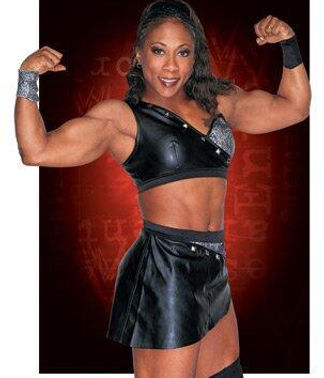
Carlene Moore-Begnaud (b. 1972), known professionally as Jazz, is widely recognized as one of the most physically dominant and credible competitors in the history of women’s professional wrestling. Her career, spanning independent promotions, Extreme Championship Wrestling, and World Wrestling Federation, reflects a period in which women’s wrestling was often constrained by limited opportunities, yet periodically redefined by performers capable of establishing legitimacy through in-ring performance.
Jazz began her professional wrestling career in the late 1990s after training under Rodney Mack. She gained early recognition in Extreme Championship Wrestling (ECW), where her presentation differed markedly from many women’s roles of the era. ECW programming and contemporary wrestling media documented her as a physically imposing competitor whose matches emphasized strength, striking, and submission-based offense, aligning more closely with the promotion’s emphasis on intensity and realism.
Her national prominence expanded following her debut in WWF in 2001. Within a short period, Jazz was positioned as a central figure in the women’s division. On February 4, 2002, she defeated Trish Stratus to win the WWF Women’s Championship. WWE archival records and Pro Wrestling Illustrated coverage noted her reign as a departure from the prevailing presentation of the division, emphasizing physical dominance and competitive credibility.
One of the most significant matches of her career occurred at WrestleMania X8 on March 17, 2002, where she defended the Women’s Championship against Stratus and Lita in a triple threat match. The bout, widely documented in WWE and wrestling media archives, is frequently cited as an example of the division’s evolving in-ring standards during the early 2000s. Jazz retained the championship, reinforcing her portrayal as a dominant champion within the division.
Jazz would go on to hold the WWF Women’s Championship multiple times, with her matches consistently emphasizing a hard-hitting, methodical style built around control and endurance. Analysts and media coverage from the period often highlighted her as one of the most legitimate competitors in the division, particularly in contrast to the more character-driven presentation that defined much of women’s wrestling during that era.
Following her tenure in WWF/WWE, Jazz continued to compete across independent promotions and later in the National Wrestling Alliance, where she captured the NWA World Women’s Championship. Her continued activity into the 2010s and beyond reflects both her longevity and her ongoing influence within women’s wrestling.
In-ring, Jazz is known for a style grounded in power, submission wrestling, and controlled pacing. Her matches frequently emphasized physicality and sustained offense, contributing to a presentation that positioned her as a credible threat in any competitive context. This approach aligned with broader efforts to reframe women’s wrestling as a serious athletic endeavor.
Historically, Jazz represents a critical moment in the early 2000s when women’s wrestling in North America briefly reasserted its emphasis on in-ring competition. Her championship reigns and match performances demonstrated that women could be presented as dominant, physically credible athletes, helping to influence later generations of performers and contributing to the ongoing evolution of the division.
Sources
WWE archival records and match histories from WWE (2001–2004).
ECW broadcast archives and event records (late 1990s–2001).
Pro Wrestling Illustrated coverage and rankings (2001–2003).
National Wrestling Alliance championship records and event archives.
WrestleMania X8 event records (March 17, 2002).
External Resources
Looking for more information? Check out these resources or follow your favorites on social media.


