

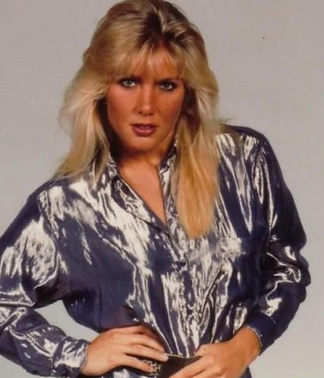
Baby Doll
Born and raised in Dallas, Baby Doll was one of the most effective talkers and characters of the territory era. Her influence showed that women could control narrative, heat, and audience reaction in a deeply Southern wrestling landscape.
Contact Information

Nickla Ann Roberts (b. 1963), known professionally as Baby Doll, was a prominent managerial figure during the 1980s territorial era, particularly within Jim Crockett Promotions. Though not primarily an in-ring competitor, her influence on professional wrestling was significant in shaping how women could function as central narrative figures within major storylines.
Roberts began her career in the early 1980s after being introduced to the wrestling business through Texas-based promotions. She gained wider recognition in Jim Crockett Promotions (JCP), a key National Wrestling Alliance territory that would later form the foundation of World Championship Wrestling. Wrestling archives and broadcast records from JCP programming document Baby Doll as a recurring presence in high-profile feuds, where her role extended beyond traditional managerial duties.
Baby Doll became most closely associated with her on-screen partnership with Dusty Rhodes, serving as his valet during a series of major storylines in the mid-1980s. Her presence at ringside often influenced match outcomes and added narrative complexity to ongoing feuds. One of the most notable angles of her career involved her storyline relationship with Magnum T.A., which culminated in a widely recognized betrayal angle that contributed to the emotional stakes of their rivalry.
In addition to her association with Rhodes and Magnum T.A., Baby Doll also played a key role in storylines involving performers such as Tully Blanchard. Her involvement in these programs demonstrated how managers could function as active participants in wrestling narratives, shaping audience reactions and enhancing the dramatic structure of matches and feuds.
Contemporary coverage from wrestling media and JCP broadcasts frequently highlighted Baby Doll’s effectiveness as a performer in a non-wrestling role. Her ability to generate audience reaction, whether through alignment with fan-favorite wrestlers or antagonistic storylines, positioned her as one of the more influential female personalities of the territorial era. At a time when women’s wrestling opportunities were limited in many promotions, managerial roles such as hers provided an alternative avenue for women to maintain visibility and influence within the industry.
While her active tenure in major promotions was relatively brief, Baby Doll’s impact lies in her contribution to the narrative dimension of professional wrestling. Historians often cite the territorial era as a period in which storytelling and character dynamics were central to audience engagement, and Baby Doll’s work exemplified how women could shape those narratives without being confined to in-ring competition.
Historically, Baby Doll represents an important aspect of women’s roles in professional wrestling beyond championship competition. Her career illustrates how women contributed to the structure and success of wrestling storytelling during the territorial era, influencing audience perception and expanding the scope of female participation within the industry.
Sources
Jim Crockett Promotions broadcast archives (mid-1980s).
National Wrestling Alliance territory records and historical summaries.
Pro Wrestling Illustrated coverage of JCP storylines (1985–1987).
WCW archival materials and historical retrospectives.
Tim Hornbaker, Legends of Pro Wrestling (Sports Publishing, 2012).
External Resources
Looking for more information? Check out these resources or follow your favorites on social media.


